Why We Evaluate Before We Enroll
The data that turns training into a plan. Every athlete starts with the same question — what do they actually need? The evaluation is how we answer it, before a single session is planned.
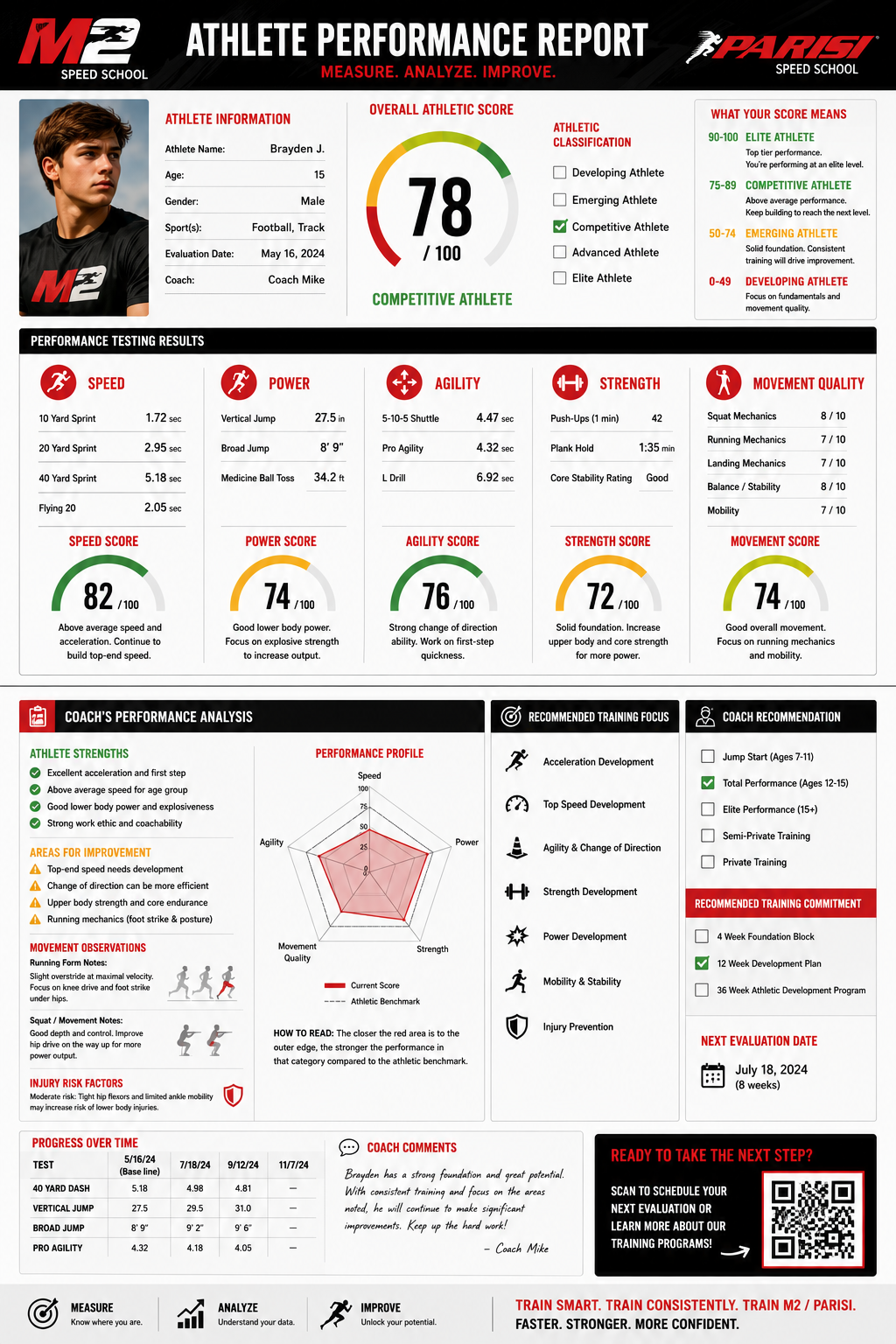
Every evaluation produces a full Athlete Performance Report — baseline numbers, a coach's analysis, and a recommended training focus.
The Purpose
The evaluation answers the questions that matter
Before we recommend a program, we answer four questions — with data, not guesswork.
Current Level
What can the athlete do today, under the same testing conditions?
Biggest Opportunity
Will better mechanics, force production, strength, or change of direction create the fastest improvement?
Right Starting Point
Which program, training group, and coaching emphasis fit the athlete now?
Proof of Progress
What numbers will we compare at the next evaluation?
The Battery
A single number never tells the whole story
We read the pattern across speed, power, strength, agility, and mechanics — five areas that together describe how an athlete moves.
Sprint
10 • 20 • 40 yd
Power
Vertical + broad jump
Strength
Pull-ups
Agility
5-10-5
Mechanics
Running analysis
Together, these results show whether the athlete needs more acceleration, force, relative strength, braking control, cleaner mechanics, or a combination.
Speed
10, 20, and 40 yards reveal different parts of speed
The same sprint, read three ways. Each split tells us something the others cannot.
First-Step Acceleration
How quickly the athlete creates force, projects forward, and gains ground from the start.
Build-Up & Transition
Whether posture and stride mechanics improve as the athlete rises and builds speed.
Top-End Speed Profile
How the athlete carries speed after acceleration and whether mechanics stay organized.
Power
The jumps show how the athlete produces force
Power is not one quality — it has a direction. We measure both.
Lower-body power directed vertically
Useful for jumping, rebounding, blocking, takeoff, and rapid force production.
Lower-body power directed horizontally
Useful for starts, acceleration, contact positions, and covering ground explosively.
Comparing both directions helps coaches see whether power transfers evenly, or whether one quality needs more attention.
Strength
Pull-ups: strength relative to body weight
One test, three qualities we can actually coach.
Control
Can the athlete move the body through a consistent range without losing position?
Capacity
Can the athlete repeat quality efforts before technique breaks down?
Balance
Does upper-body pulling strength support posture, arm action, contact, and total athletic development?
The 5-10-5 shows how speed changes direction
Change of direction is four skills stacked together. We look at each one.
Accelerate
Win the first steps
Brake
Lower and control the body
Re-Direct
Push out of the cut
Re-Accelerate
Regain speed quickly
The total time matters. The movement quality explains why the time happened.
Mechanics
Running analysis connects the stopwatch to movement
A time tells us what happened. Video and coaching observation help explain how it happened — and that distinction changes the training plan.
One athlete may need more force. Another may need a better starting position, cleaner front-side mechanics, or improved control at speed.
What we observe
Why it matters
Individual coaching begins with an individual reason.
Interpretation
The complete profile guides the recommendation
Results are read as a pattern — and every pattern points to a training emphasis.
The Process
How evaluation data becomes an athlete plan
Measure
Standardized tests create the baseline
Interpret
Coaches identify strengths and limiting factors
Place
We recommend the right program and starting group
Train
Sessions emphasize the athlete's highest priorities
Retest
New data shows what changed and what comes next
This process gives parents a reason for the recommendation and gives coaches a standard for accountability.
What You Get
What the parent and athlete receive
A Baseline
Clear starting numbers for speed, power, strength, and agility
A Coach's Explanation
What the numbers and running analysis reveal
A Training Recommendation
The program, frequency, and priorities that fit the athlete
A Progress Standard
Specific measures to compare at re-evaluation
The goal: every family understands why the athlete is starting here and what improvement should look like.
The best training plan starts with the right baseline
Your athlete is more than a 40-yard time. The evaluation shows us where they are, what is holding them back, and where coaching can make the biggest difference.
Schedule the Performance EvaluationQuestions? Call (574) 766-6278